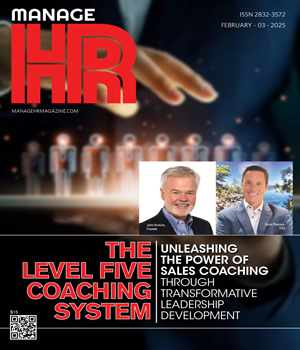
The Level Five Coaching System: Unleashing The Power Of Sales Coaching Through Transformative Leadership Development

DEI Consultant of The Year - 2025

The HR and talent acquisition space is undergoing a seismic shift driven by technological advancements and a heightened focus on diversity and inclusion. Organizations that prioritize the integration of DEI principles with sales training in their HR strategies are better equipped to attract diverse talent and foster equitable workplaces.

The global human resource professional services market was valued at $6.39 billion in 2024 and is projected to grow at a CAGR of 13.4 percent from 2025 to 2030. The growth can be attributed to the heightened importance of ensuring fairness in decision-making during the hiring process and promoting a sense of belonging among employees to boost retention.

Companies are driving their efforts to create inclusive workplaces by implementing blind hiring practices, forming employee resource groups, and conducting regular audits of hiring and promotion processes. More than ethical obligations, these initiatives serve as catalysts for innovation as diverse teams consistently achieve better performance than their homogenous counterparts.

Emphasis is placed on creating equitable benefits packages and addressing workplace discrimination to advance DEI goals with the goal of removing unconscious bias. Teams are trained in cultural intelligence to navigate diverse environments with sensitivity and adaptability.

In this edition of Manage HR, we explore how companies actively align with effective practices to boost retention and motivation among their workforce.

We feature insights from industry experts like Gina Elliott, senior director of learning and development at Altitude Trampoline Park, who emphasizes delivering impactful instructional content through workshops that foster the professional growth of entire workforces.

We also feature David Gonzalez, VP and head of human resources at Natera, who believes in improving the quality of candidates by eliminating human biases and identifying skills that might be overlooked by traditional methods.

In this edition featuring the top HR companies, we aim to help you find the right partner for your business requirements.
    DEI Consultant of The Year

    SPARK Equity in Action is a consulting firm that offers tailored strategies, leadership coaching, training, resources and assessments to foster inclusive and equitable environments. The company is guided by core values like inclusion, integrity, and intentionality to create systemic change through intentional conversations and strategic action. ... read full profile

Diversity and Inclusion Info

Q1
What Do Diversity and Inclusion Companies Do?
Diversity and inclusion companies help organizations create workplaces that feel more equitable, representative and respectful across different employee groups. In the context of Top Companies in Diversity and Inclusion, providers may support leadership training, inclusive hiring practices, culture assessments, equity reviews, employee engagement programs and workplace behavior initiatives. Their role usually extends beyond policy recommendations alone. Strong diversity and inclusion providers help organizations turn broad intentions into practical workplace habits that employees and managers can apply consistently in day-to-day interactions. In many cases, the real challenge is not writing policies. It is creating environments where participation, trust and accountability improve across teams with different experiences, backgrounds and communication styles.
Q2
Why Do Diversity and Inclusion Companies Matter Now?
The importance of Top Companies in Diversity and Inclusion has grown as organizations manage more complex workforce structures across the APAC region. Hybrid work models, cross-border hiring and generational differences have changed how employees experience workplace culture. In APAC especially, diversity conversations are shaped by language, cultural expectations and regional employment norms that vary significantly between markets. Organizations increasingly need diversity and inclusion companies that understand local context while still helping leadership teams maintain consistent workplace standards across locations. Demand is also shifting away from image-focused initiatives. Businesses are paying closer attention to retention, leadership quality, collaboration and employee trust because those areas tend to affect long-term workforce stability more directly.
Q3
How Should Organizations Evaluate Diversity and Inclusion Providers?
Organizations evaluating diversity and inclusion providers should first assess whether a firm can identify workplace barriers realistically before recommending solutions. Some providers rely heavily on standardized workshops without fully understanding organizational culture, leadership dynamics or workforce maturity levels. More effective firms usually combine facilitation skills, evidence-based assessment methods and practical implementation support. Buyers should also examine how providers measure progress and adapt programs across industries, geographies and workforce structures. A strategy that works in one environment may not translate effectively into another. Within Top Companies in Diversity and Inclusion, credibility tends to come from depth of expertise and practical workplace understanding rather than broad culture-change messaging alone.
Q4
What Business Value Can Diversity and Inclusion Programs Create?
Effective DEI programs can improve trust, communication and collaboration across teams working in different roles, regions and operational environments. When inclusion efforts are tied to everyday management behavior instead of isolated campaigns, organizations often see stronger employee participation and clearer accountability across departments. For companies comparing diversity and inclusion companies, the value usually becomes visible through workplace outcomes rather than public positioning. Better hiring consistency, improved retention and stronger leadership readiness are often linked to environments where employees feel they can contribute more openly and consistently. The long-term impact typically depends on whether inclusion practices become part of normal workplace behavior instead of remaining separate initiatives managed only through HR programs.
Q5
What Role Does Technology Play in Diversity and Inclusion Work?
Technology now plays a larger role in diversity and inclusion work, particularly in areas such as sentiment tracking, assessment reporting, training access and progress measurement. Digital tools can help organizations identify recurring patterns, monitor participation and scale learning programs across larger or distributed workforces. Even so, technology works best when it supports human judgment rather than replacing it entirely. Top Companies in Diversity and Inclusion are often differentiated by how effectively they combine data, facilitation expertise and contextual understanding. A dashboard alone rarely explains why workplace barriers exist or how leadership behavior influences inclusion outcomes. Technology adds the most value when it helps organizations make clearer decisions and sustain practical action over time.
Q6
What Should Decision-Makers Prioritize When Comparing Providers?
Decision-makers comparing Top Companies in Diversity and Inclusion should prioritize credibility, organizational fit and the provider’s ability to work within real workplace complexity. The strongest providers usually understand how leadership behavior, employee experience, workplace policy and organizational culture influence one another instead of treating them as separate issues. For APAC organizations, regional sensitivity also matters because inclusion challenges often vary between countries, industries and workforce structures. Programs that feel effective in one market may require substantial adjustment elsewhere. Organizations reviewing diversity and inclusion providers generally benefit more from firms that connect strategy with measurable adoption, leadership accountability and sustained workplace participation over time.
Take Me Top